
Table of Contents
ToggleIntroduction to Key B2B Lead Generation Mistakes Companies Must Avoid in 2026
B2B lead generation mistakes are the biggest reason many companies struggle to build predictable sales pipelines in 2026. In the modern day and age, the key to success is high-quality leads, intent, trust, and relationship building across SEO, content, and social media marketing. However, businesses are still glued to outdated and rushed lead generation strategies that burn money, weaken brand authority, and stunt long-term growth.
After over 12 years of experience in SEO, social media marketing, and B2B content strategy, I’ve noticed a consistent pattern across industries. It is not that businesses fail because they do not get enough leads; the truth is that businesses fail because they make critical B2B lead generation mistakes—many of which go unnoticed until the sales pipeline begins to dry up.
Understanding why B2B lead generation is failing is far more important in 2026 than ever before. Poor targeting, weak value propositions, ineffective nurturing through email and social media marketing, and a complete lack of search and buyer intent alignment are key reasons businesses struggle to convert interest into qualified leads. Following best practices in B2B lead generation—supported by SEO, content, and social media channels—is no longer optional.
This blog post examines the most damaging B2B lead generation mistakes businesses must avoid in 2026 and explains why these errors directly impact growth in a highly competitive digital environment. It also highlights how a data-driven agency like tanvidigihub solves these challenges using a search engine optimization–led, social media marketing–integrated, and results-focused strategy. This guide will help you refine your B2B lead generation efforts and build a sustainable, high-intent sales pipeline.
Why B2B Lead Generation Mistakes Matter in 2026
Businesses that ignore B2B lead generation mistakes often waste budget and lose qualified leads. The use of consumer intelligence within branding is a significant reason why this issue remains more relevant than ever. AI platforms can currently summarize information, suggest suppliers, and shape B2B purchasing searches. If you are not using authority content within your strategy, then your business could potentially be excluded from AI-based searches, thereby illustrating why B2B lead generation can often fail.
In the past, the B2B buyer trusted advertisements as the authority in purchasing decisions but not anymore. Presently, the B2B buyer trusts the following:
- Educational, problem-solving content
- Detailed case studies and proven results
- Real industry experience and expertise
- A consistent and authoritative online presence
When businesses commit common B2B lead generation errors—such as publishing shallow content or failing to demonstrate expertise—trust erodes quickly. Even with high website traffic, weak credibility leads to poor conversion rates.
Another major outcome of B2B lead generation strategy mistakes is increased budget wastage. Running ad campaigns without fixing foundational issues often results in low ROI. At tanvidigihub, many clients reach out after investing months in paid advertising without receiving qualified leads. In most cases, the problem is not ad visibility but the absence of B2B lead generation best practices, such as intent-based targeting, content-led funnels, and structured lead nurturing.
Sales and marketing alignment is no longer optional in 2026—it is a necessity. When these teams operate in isolation, lead leakage becomes unavoidable. Common problems include:
- Delayed or inconsistent lead follow-ups
- Mismatched expectations between marketing and sales
- Poor lead qualification and scoring
- Inaccurate revenue forecasting
These gaps are among the most damaging B2B lead generation mistakes, directly affecting scalability and long-term growth.
In an AI-influenced, trust-driven B2B landscape, avoiding B2B lead generation mistakes requires a strategic shift. Businesses that eliminate common B2B lead generation errors, align teams, and follow proven B2B lead generation best practices are far more likely to build authority, attract high-intent leads, and achieve sustainable growth in 2026 and beyond.
Most Damaging B2B Lead Generation Mistakes Businesses Make
Below are the most damaging B2B lead generation mistakes businesses continue to make in 2026. These errors directly explain why B2B lead generation fails even when companies invest heavily in marketing and sales tools.
1. Targeting Everyone Instead of Ideal Customers
One of the most common B2B lead generation errors is failing to define a clear Ideal Customer Profile (ICP). When messaging is broad and non-specific, it attracts the wrong audience and wastes resources.
This results in:
- Low-quality leads
- High bounce rates
- Poor sales conversions
Effective marketers focus on decision-makers with clear intent. At tanvidigihub, we help brands refine ICPs based on:
- Industry type
- Company size
- Decision-maker roles
- Search and intent signals
This approach aligns with proven B2B lead generation best practices and significantly improves lead quality.
2. Ignoring Content Marketing in B2B Lead Generation
Many companies still underestimate content marketing, making this one of the biggest B2B lead generation strategy mistakes in 2026.
Without blogs, guides, videos, and case studies:
- Buyers don’t trust your brand
- AI tools don’t reference your website
- SEO visibility remains weak
Content is no longer optional—it is a lead qualification tool and a core part of modern B2B lead generation best practices.
3. Focusing on Quantity Instead of Lead Quality
Collecting hundreds of leads has little value if sales teams cannot convert them. This mistake is a major reason why B2B lead generation fails.
High-quality B2B lead generation focuses on:
- Intent-based targeting
- Lead scoring systems
- Structured nurturing sequences
In 2026, quality always outperforms quantity.
4. Weak Landing Pages That Don’t Convert
Driving traffic to poorly optimized landing pages is another critical B2B lead generation mistake.
Common issues include:
- No clear value proposition
- Generic or weak CTAs
- Slow mobile loading speed
- Lack of trust signals (reviews, case studies, logos)
At tanvidigihub, conversion-optimized landing pages alone have improved B2B conversion rates by over 40%.
5. Not Using CRM and Automation Effectively
Many businesses collect leads but fail to follow up consistently. Without proper CRM and automation, leads quickly go cold.
This leads to:
- Missed revenue opportunities
- Poor lead tracking
- Inconsistent communication
Automation ensures timely follow-ups while maintaining personalization—an essential part of B2B lead generation best practices.
6. Over-Reliance on Paid Ads Alone
Paid ads can generate instant leads, but relying on them entirely is a serious B2B lead generation strategy mistake.
When ads stop:
- Leads stop
- Costs increase
- Growth becomes unstable
Balanced B2B lead generation in 2026 integrates:
- SEO and organic search
- Content marketing
- Email nurturing
- Paid advertising
7. Poor Sales and Marketing Alignment
When marketing delivers leads sales teams don’t want, internal friction begins. This B2B lead generation mistake results in:
- Low close rates
- Wasted leads
- Broken growth pipelines
Clear lead qualification criteria, shared KPIs, and regular feedback loops fix this gap.
8. Ignoring Data, Analytics, and Attribution
Many companies still make decisions without data. In 2026, this is one of the most dangerous common B2B lead generation errors.
Without analytics:
- Optimization becomes guesswork
- ROI remains unclear
- Scaling becomes impossible
Data-driven decision-making separates scalable businesses from struggling ones.
9. Generic Messaging That Ignores Buyer Pain Points
B2B buyers respond to solutions—not features. Generic messaging is easily ignored.
Strong lead generation messaging speaks directly to:
- Business pain points
- ROI-driven outcomes
- Industry-specific challenges
Failing to personalize messaging is a key reason why B2B lead generation fails.
10. Not Optimizing for AI, AEO, and GEO
Modern lead generation must work across:
- Search engines
- Answer engines
- Generative AI platforms
Brands that fail to optimize for AI visibility, AEO, and GEO lose future-ready leads. Avoiding this is now a critical part of B2B lead generation best practices.
Benefits of Avoiding B2B Lead Generation Mistakes in 2026
By identifying and correcting B2B lead generation mistakes, businesses can unlock significant and measurable advantages. Many organizations struggle not because of limited demand, but because of common B2B lead generation errors and B2B lead generation strategy mistakes that weaken their marketing and sales performance.
Key Benefits of Fixing B2B Lead Generation Issues
- Better-Quality Leads
More precise targeting and relevant messaging attract decision-makers who are actively prepared to evaluate and purchase solutions.
- Lower Cost Per Lead (CPL)
Optimized funnels eliminate wasted ad spend and inefficiencies, directly addressing one of the biggest reasons why B2B lead generation fails.
- Shorter Sales Cycles
Educated and nurtured leads convert faster, reducing follow-ups and accelerating deal closures.
- Greater Brand Authority and Trust
Consistent, reliable, and value-driven content strengthens credibility—one of the most important B2B lead generation best practices in 2026.
- Scalable and Predictable Growth
Eliminating B2B lead generation mistakes creates structured pipelines that support sustainable growth and accurate revenue forecasting.
At tanvidigihub, clients who corrected these B2B lead generation strategy mistakes achieved long-term, sustainable growth without increasing their advertising budgets. By focusing on intent-based targeting, content-led funnels, and data-driven optimization, businesses were able to generate high-quality leads consistently while maintaining cost efficiency.
Latest Trends & Insights in B2B Lead Generation for 2026
As we move deeper into 2026, the landscape of B2B digital marketing continues to evolve rapidly. Understanding the latest trends and insights is essential to avoid B2B lead generation mistakes and implement B2B lead generation best practices that drive sustainable growth. In today’s competitive environment, success depends on how effectively businesses align SEO, content, automation, and overall digital marketing strategy. Below are the key developments shaping how companies generate, nurture, and convert B2B leads in 2026.
1. AI-Powered Personalization is Now Standard
Modern B2B buyers expect tailored experiences—just like in B2C. Artificial Intelligence (AI) is no longer a luxury but a necessity for personalized engagement. Tools like ChatGPT, Gemini, and advanced CRMs analyze behavior and preferences to deliver custom content, product recommendations, and follow-up messages.
Without this level of personalization, your content may be overlooked, contributing to common B2B lead generation errors and lowering conversion rates.
2. Content Continues to Dominate the Funnel
Content is no longer just for awareness; it has become a lead qualification tool. High-value assets such as:
- Long-form blogs
- In-depth guides
- Case studies
- Video tutorials
- Interactive tools
help educate prospects and signal buying intent to sales teams. Brands that ignore content as a strategic asset are often left asking why B2B lead generation fails, even with significant traffic.
3. Intent Data and Predictive Analytics Are Game Changers
Using intent data—such as search behavior, content consumption, and interaction history—enables marketers to prioritize high-potential leads. Predictive analytics further forecasts buying likelihood, enabling sales teams to focus on the right accounts at the right time.
This trend helps eliminate B2B lead generation strategy mistakes like untargeted outreach and generic campaigns.
4. SEO Isn’t Just for Search Engines Anymore—It’s for AI Visibility
Search Engine Optimization (SEO) still matters, but in 2026, it’s equally important to optimize for Answer Engine Optimization (AEO) and AI discovery platforms. Content must be structured in a way that AI tools can easily interpret and recommend it as answers to business queries.
Brands that fail to optimize for AI visibility may not appear in generative search responses—another reason why B2B lead generation fails for some companies.
5. Holistic Funnels Replace Single-Touch Campaigns
Today’s buyer journeys are non-linear. Leads move between channels—search, email, social, video, and direct contact—before converting. A holistic funnel aligns these touchpoints, providing consistent messaging and nurturing across all stages.
This approach is one of the most effective B2B lead generation best practices to eliminate drop-offs.
6. First-Party Data Is the New Gold
With third-party cookies becoming less reliable, first-party data (collected directly from your audience) has emerged as the most valuable asset for targeting, personalization, and optimization. Companies that prioritize first-party data insights are better equipped to build predictive and scalable pipelines.
7. Sales and Marketing Alignment Is Now Mission-Critical
In 2026, integration between sales and marketing is no longer an optional improvement—it’s a necessity. Shared KPIs, regular feedback loops, and integrated tools ensure that leads are properly qualified, nurtured, and passed to sales at the right time.
Misalignment continues to be one of the most damaging B2B lead generation mistakes businesses make.
8. Trust and Authority Signal Dominance in Decision-Making
Buyers research extensively before they engage. Trust signals such as expert content, case studies, customer testimonials, and transparent pricing influence decisions more than ads. Brands that lack strong authority often ask why B2B lead generation fails, despite high traffic volumes.
9. Automation Enhances, Not Replaces, Human Touch
Automation tools are indispensable for scaling follow-ups, nurturing sequences, and lead scoring. However, personalization and human connection remain essential—especially in high-value B2B relationships. Smart automation combined with human insight is one of the most advanced B2B lead generation best practices today.
10. Measurement and Attribution Drive Optimization
Accurate measurement and multi-touch attribution models help marketers understand which channels and content pieces influence conversions. This insight prevents wasted spend and ensures that budget allocation aligns with performance—reducing common B2B lead generation errors and improving overall ROI.

Challenges Companies Face While Fixing Lead Generation Mistakes
Identifying B2B lead generation mistakes is only the first step. The real challenge begins when businesses try to fix them. In 2026, companies face multiple operational, strategic, and mindset-related obstacles that slow down improvement and explain why B2B lead generation fails even after awareness is created.
One of the biggest challenges is lack of clarity in strategy. Many organizations know something is wrong but cannot pinpoint whether the issue lies in targeting, messaging, channels, or funnel design. These unclear priorities often lead to repeated B2B lead generation strategy mistakes, where changes are made randomly without data-backed direction.
Another major hurdle is limited internal expertise. Modern lead generation requires skills across SEO, content marketing, data analytics, automation, and AI optimization. Businesses that rely on outdated knowledge or siloed teams often repeat common B2B lead generation errors, such as poor audience targeting or weak nurturing workflows.
Key Challenges Businesses Commonly Face
Resistance to Change
Teams often stick to familiar tactics, even when results decline. This prevents adoption of modern B2B lead generation best practices.
Budget Constraints and Misallocation
Many companies continue spending on ads instead of fixing foundational issues like content, SEO, and conversion optimization.
Technology Overload
Using multiple tools without proper integration leads to poor tracking, missed follow-ups, and inefficient funnels.
Sales and Marketing Misalignment
Even after identifying issues, lack of collaboration causes lead leakage and poor conversion rates.
Inconsistent Execution
Fixing B2B lead generation mistakes requires consistency. Stopping optimization too early often results in stalled growth.
Another common challenge is measuring the right metrics. Many businesses track traffic and impressions instead of lead quality, intent, and conversion rates. Without clear attribution, teams struggle to understand what’s working—reinforcing why B2B lead generation fails despite effort and spend.
At tanvidigihub, we often see companies overwhelmed by these challenges. However, once businesses address them systematically—by correcting common B2B lead generation errors, aligning teams, and following proven B2B lead generation best practices—lead quality improves and pipelines become predictable.
In 2026, fixing lead generation issues is not a one-time task but an ongoing process. Companies that accept this reality and invest in long-term optimization are the ones that successfully turn challenges into scalable growth opportunities.
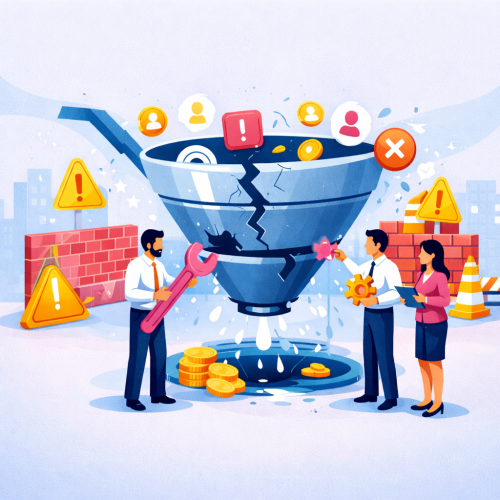
Real-Life Example from Tanvi’s Digital Hub
At Tanvi’s Digital Hub (tanvidigihub), we regularly work with B2B companies that approach us after struggling for months with poor-quality leads, high ad spend, and low conversions. One such real-life example clearly highlights how fixing B2B lead generation mistakes can completely transform business outcomes.
The Challenge
- A mid-sized B2B service provider came to tanvidigihub with a common complaint:
- “We are generating leads, but none of them are converting.”
- After a detailed audit, we identified multiple common B2B lead generation errors, including:
- Targeting a very broad audience with no defined ICP
- Heavy dependence on paid ads with no organic or content support
- Generic landing page messaging with weak CTAs
- No lead nurturing or CRM-based follow-ups
- Sales and marketing working in silos
These B2B lead generation strategy mistakes explained exactly why B2B lead generation fails even when traffic and lead volume look healthy on paper.
The Strategy Implemented
Instead of increasing ad spend, Tanvi’s Digital Hub focused on fixing the foundation using proven B2B lead generation best practices:
- Redefined the Ideal Customer Profile based on industry, role, and intent
- Rebuilt landing pages with clear value propositions and trust signals
- Introduced SEO-driven, authority-based content to attract high-intent traffic
- Set up lead scoring and automated nurturing sequences
- Aligned sales and marketing with shared qualification criteria
The Results
Within 90 days of implementing these changes, the client experienced:
- 45% improvement in lead quality
- 38% reduction in cost per lead
- Shorter sales cycles due to better-informed prospects
- Consistent inbound leads without increasing ad spend
Most importantly, the business moved from unpredictable results to a scalable and reliable lead generation pipeline.
Conclusion
In 2026, sustainable growth depends on a company’s ability to recognize and eliminate B2B lead generation mistakes before they damage revenue and brand credibility. As buyer behavior shifts toward AI-driven research, intent-based decision-making, and trust-led engagement, relying on outdated tactics only increases common B2B lead generation errors and weakens conversion potential.
Businesses that continue to ignore audience targeting, content authority, data insights, and sales–marketing alignment will keep wondering why B2B lead generation fails—even with strong traffic and ad spend. In contrast, organizations that correct B2B lead generation strategy mistakes and adopt proven B2B lead generation best practices—such as intent-focused SEO, content-led funnels, automation, and analytics—build predictable and scalable pipelines.
Real-world results from Tanvi’s Digital Hub, supported by insights and frameworks aligned with the Ahmedabad School of Digital Marketing, demonstrate that fixing foundational issues leads to higher-quality leads, lower acquisition costs, and shorter sales cycles—without increasing advertising budgets.
The key takeaway is clear: success in 2026 is not about generating more leads, but about generating the right leads through smarter, data-driven strategies.
If your business is serious about long-term growth, now is the time to audit your funnel, fix critical gaps, and move forward with a lead generation strategy built for the future.
FAQ
The most common B2B lead generation mistakes include targeting the wrong audience, relying only on paid ads, ignoring lead nurturing, poor follow-up processes, and not aligning marketing with sales teams.