
Table of Contents
ToggleIntroduction to Content Marketing vs Performance Marketing: Full Comparison for 2026
The debate around content marketing vs performance marketing has become more important than ever in 2026. As digital platforms evolve, ad costs rise, and consumers become more selective, businesses are rethinking how they attract, engage, and convert their audience. Choosing the wrong approach can slow growth, waste budget, and reduce long-term impact.
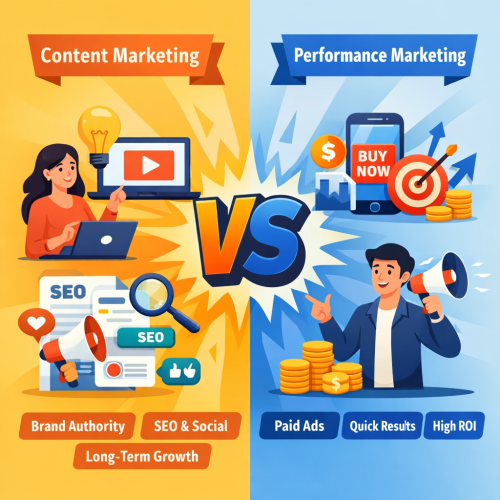
Content marketing vs performance marketing 2026 is not just about organic content versus paid ads. It is about understanding how each strategy supports different business goals. Content marketing focuses on building trust, authority, and long-term visibility through blogs, videos, SEO, and social media content. In contrast, performance marketing delivers fast, measurable results through paid campaigns on platforms like Google Ads, Meta Ads, and other performance-driven channels, where every click, lead, or sale is tracked.
To clearly understand the difference between content marketing and performance marketing, businesses must evaluate factors like cost, ROI, scalability, and customer journey stage. A strong performance marketing vs content marketing strategy depends on whether your priority is quick conversions through tools like Google Ads, long-term brand credibility, or sustainable growth through organic visibility.
This guide will break down every aspect to help you decide which is better—content marketing or performance marketing for your business in 2026. By the end of this comparison, you’ll know how to use each approach strategically or combine both for maximum results.
Introduction to Content Marketing
- SEO blog posts
- Website pages and landing pages
- Case studies and guides
- Email newsletters
- Social media content
- Videos, podcasts, and infographics
Introduction to Performance Marketing
- Clicks
- Leads
- App installs
- Purchases
- Google Ads
- Meta Ads (Facebook & Instagram)
- LinkedIn Ads
- Influencer performance campaigns
- Affiliate marketing
Why Content Marketing vs Performance Marketing Matters in 2026
- Compare brands across multiple platforms
- Research before purchasing
- Expect value before commitment
- SEO blogs
- Evergreen reels
- Educational emails
- Weak landing pages
- Poor messaging
- No social proof
- Ad creatives
- Landing page copy
- Retargeting sequences
- Content lowers long-term CAC
- Performance marketing optimizes scale
- Content marketing builds authority
- Performance marketing accelerates results
- Data from ads improves content strategy
- Content improves ad efficiency
Key Differences Between Content Marketing and Performance Marketing
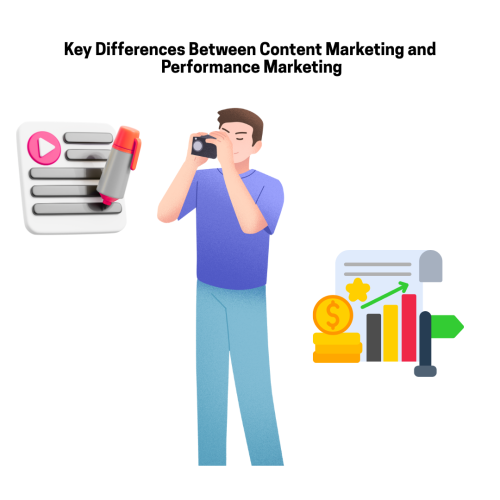
The core difference lies in intent and timeline.
Content marketing focuses on:
- Long-term brand building
- Organic traffic growth
- Trust and authority
- SEO and AI visibility
Performance marketing focuses on:
- Immediate conversions
- Paid traffic
- Short-term ROI
- Measurable actions
Content marketing compounds over time. Performance marketing delivers fast but stops when the budget stops.
Cost Comparison: Content Marketing vs Performance Marketing
When considering cost-effectiveness, content marketing and performance marketing use two models that vary greatly in expenditure. This distinction is extremely important in digital marketing in 2026, where rising competition and platform saturation directly impact acquisition costs. Content marketing usually includes an initial investment to create high-quality assets such as blog posts, SEO-optimized pages, social media content, videos, email sequences, and other long-form digital marketing materials. Although this may seem time- or cost-intensive at the beginning, a crucial point to understand is that this content continues to generate traffic and leads long after creation. In digital marketing, content marketing benefits from compounding returns, meaning the cost per lead steadily decreases over time.
On the other hand, performance marketing in digital marketing operates on a continuous spending model where results are directly tied to ad spend. Every click, impression, or conversion creates a direct cost to the business through platforms like Google Ads and Meta Ads. While performance marketing delivers immediate visibility and measurable outcomes, it becomes increasingly expensive as competition rises and cost-per-click rates surge in 2026. The moment ad budgets are paused, traffic and lead generation drop instantly, leaving little to no residual value from previous digital marketing spend.
From a long-term digital marketing cost perspective, content marketing functions as an investment that builds brand equity and organic demand over time, whereas performance marketing behaves like a recurring expense required to keep results flowing. Brands that rely solely on paid digital marketing channels often experience rising customer acquisition costs and shrinking profit margins. In contrast, brands that prioritize content marketing gradually reduce their dependency on ads and achieve more stable, predictable growth.
Ultimately, the most cost-effective digital marketing strategy in 2026 is not about choosing content marketing over performance marketing, but about using content to reduce long-term acquisition costs and leveraging performance marketing to efficiently scale strategies that are already proven to convert.

SEO and Organic Growth Impact
SEO has a deep and long-term impact on organic growth, making it one of the most reliable digital marketing strategies in 2026. When businesses invest in SEO, they focus on optimizing their website structure, improving page speed and mobile experience, targeting the right keywords, and creating high-quality, helpful content that genuinely answers user search queries. This approach allows brands to rank higher in search engine results and consistently attract users with strong intent, such as those searching for solutions, comparisons, or purchase-ready keywords.
Unlike paid advertising, where traffic disappears the moment ad spend stops, SEO-driven organic traffic continues to grow over time. Each optimized blog post, product page, or landing page becomes a long-term asset that keeps generating visibility, clicks, and leads. As more quality content is published and indexed, domain authority improves, helping newer pages rank faster and more easily. This compounding effect makes organic growth more predictable and cost-efficient in the long run.
SEO also plays a major role in building trust and credibility. Users tend to trust organic search results more than paid ads, especially for research-heavy or high-value purchases. Consistently appearing on the first page for relevant keywords positions a brand as an authority in its industry. In 2026, with search engines prioritizing experience, expertise, and helpful content, brands that invest in SEO are rewarded with higher rankings, better engagement, and stronger customer loyalty.
From a business perspective, strong SEO significantly lowers customer acquisition costs while improving conversion quality. Organic visitors are often more engaged and more likely to convert because they arrive with clear intent. Over time, SEO transforms content into a sustainable growth engine that supports brand visibility, lead generation, and revenue—without being dependent on rising ad costs. In short, SEO is not just a traffic strategy; it is a foundation for long-term organic growth and digital stability.
Conversion Quality and Buyer Intent
Performance marketing targets users actively searching or browsing with buying intent. This results in faster conversions but lower trust initially.
Content marketing nurtures users. By the time they convert, they already trust your brand, resulting in:
- Higher lifetime value
- Better repeat purchases
- Greater brand loyalty
That is the reason why high-ticket services and B2B businesses tend to perform better when their customer acquisition funnels are led by content marketing
Role of AI, AEO & GEO in 2026
In 2026, AI, AEO (Answer Engine Optimization), and GEO (Generative Engine Optimization) are reshaping how users discover information and how brands gain visibility online. Traditional SEO alone is no longer enough, as AI-powered search engines and generative platforms now summarize, recommend, and directly answer user queries instead of simply listing links. AI plays a central role in understanding user intent, context, and behavior, enabling search engines to deliver highly personalized and conversational results. This shift means content must be clearer, more structured, and genuinely helpful rather than keyword-stuffed.
AEO has become essential because users increasingly rely on voice search, featured snippets, and AI-generated answers. Optimizing for AEO involves creating content that directly answers questions, uses simple language, follows logical formatting, and provides concise yet authoritative responses. Brands that optimize for AEO improve their chances of being selected as the “best answer,” gaining visibility even without a traditional click. At the same time, GEO focuses on optimizing content so it can be accurately understood, summarized, and cited by generative AI tools such as AI search assistants and chat-based engines. This requires strong topical authority, trustworthy data, and experience-driven insights that AI systems consider reliable.
Together, AI, AEO, and GEO push businesses to move beyond traffic-only strategies and focus on visibility, credibility, and usefulness across AI-driven platforms. In 2026, brands that adapt to these changes benefit from higher trust, stronger organic presence, and sustained discoverability—while those that ignore them risk becoming invisible in a search landscape dominated by AI-generated answers.
Real-Life Use Cases
An e-commerce brand we worked with relied entirely on Meta Ads. Sales dropped whenever ads paused. After implementing SEO-driven content marketing, organic sales covered 60% of monthly revenue within 9 months.
A service-based startup used performance marketing for lead generation but added blogs and case studies. Lead quality improved, and ad costs reduced by 35%.
These examples show why choosing between content marketing vs performance marketing should never be an “either-or” decision.
Challenges of Content Marketing
- Content marketing requires time
- Nothing happens overnight
- Substandard content
- irregular postings
- absence of optimizing means failure.
Many firms abandon content marketing efforts too early. Tanvi’s Digital Hub promotes patience, tracking, and optimizing, as discussed in this topic.
Challenges of Performance Marketing
Performance marketing faces:
- Rising ad costs
- Platform dependency
- Ad fatigue
- Policy changes
Without strong branding and content support, performance campaigns become expensive and unstable.
Which Strategy Is Best for Your Business?
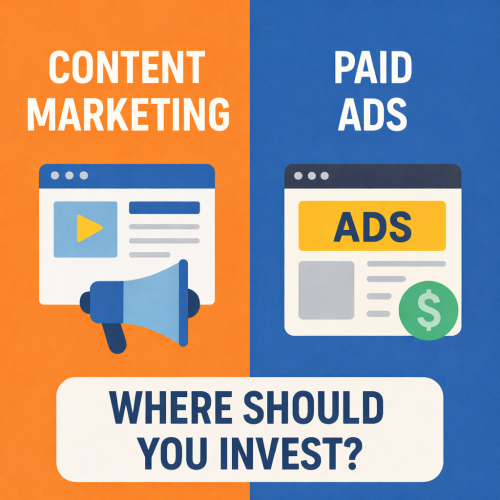
Choosing the right marketing strategy in 2026 depends on your business goals, budget, and growth timeline. There is no one-size-fits-all answer—the best strategy is the one that aligns with how fast you need results and how sustainable you want your growth to be.
If your business needs quick leads, fast sales, or immediate visibility, performance marketing is the right choice. Paid ads help you test offers, target specific audiences, and generate instant traffic. This approach works well for new product launches, limited-time campaigns, or businesses that need cash flow quickly. However, it requires a continuous budget, and results stop as soon as ad spend pauses.
If your goal is long-term growth, brand authority, and lower customer acquisition costs, content marketing is the better option. SEO-driven blogs, social media content, emails, and videos help build trust, organic traffic, and consistent leads over time. While content marketing takes longer to show results, it delivers compounding returns and reduces dependency on paid ads.
For most businesses in 2026, the best strategy is a hybrid approach. Content marketing builds a strong foundation of trust and organic visibility, while performance marketing accelerates growth by scaling what already works. This balanced strategy—often emphasized by leading institutes like Ahmedabad School of Digital Marketing—creates predictable, cost-efficient, and sustainable business growth.
Conclusion: Content Marketing vs Performance Marketing in 2026